tsconfig.json, vue-tsc runs as part of npm run lint, and ESLint understands .ts files and <script setup lang="ts"> blocks. CI and the pre-commit hook gate on it like they do on lint.
The app talks to the flight controller through a large, loosely typed object graph: the FC state, MSP replies, CLI output. Most of the bugs we chase are shape mismatches: a field that moved, a null nobody handled, a wire format that changed. Last week a port-annotation feature was built against a function mask the firmware had already stopped sending; the code was fine, the assumption was not. Types make those assumptions visible, and the compiler enforces them on every refactor rather than relying on grep.
src/js (MSP, FC, serial) stays JavaScript. Users see no change..ts files or <script setup lang="ts">, in strict mode from day one.allowJs lets TypeScript consume it; checkJs: false means it is not type-checked. Where TS needs a shape from a JS module, a JSDoc @type on that module is enough.allowJs is switched off there and the FC state gets a sealed interface. That is the next phase, tracked in the repository's AGENTS.md.Nothing changes in how you build or run the app. npm run lint now includes the type-check; npm run typecheck runs it alone. If you open a pull request that adds a JavaScript file where a TypeScript one would do, expect a reviewer to ask for the .ts version.
Questions and discussion are welcome in the development channels on the Betaflight Discord.
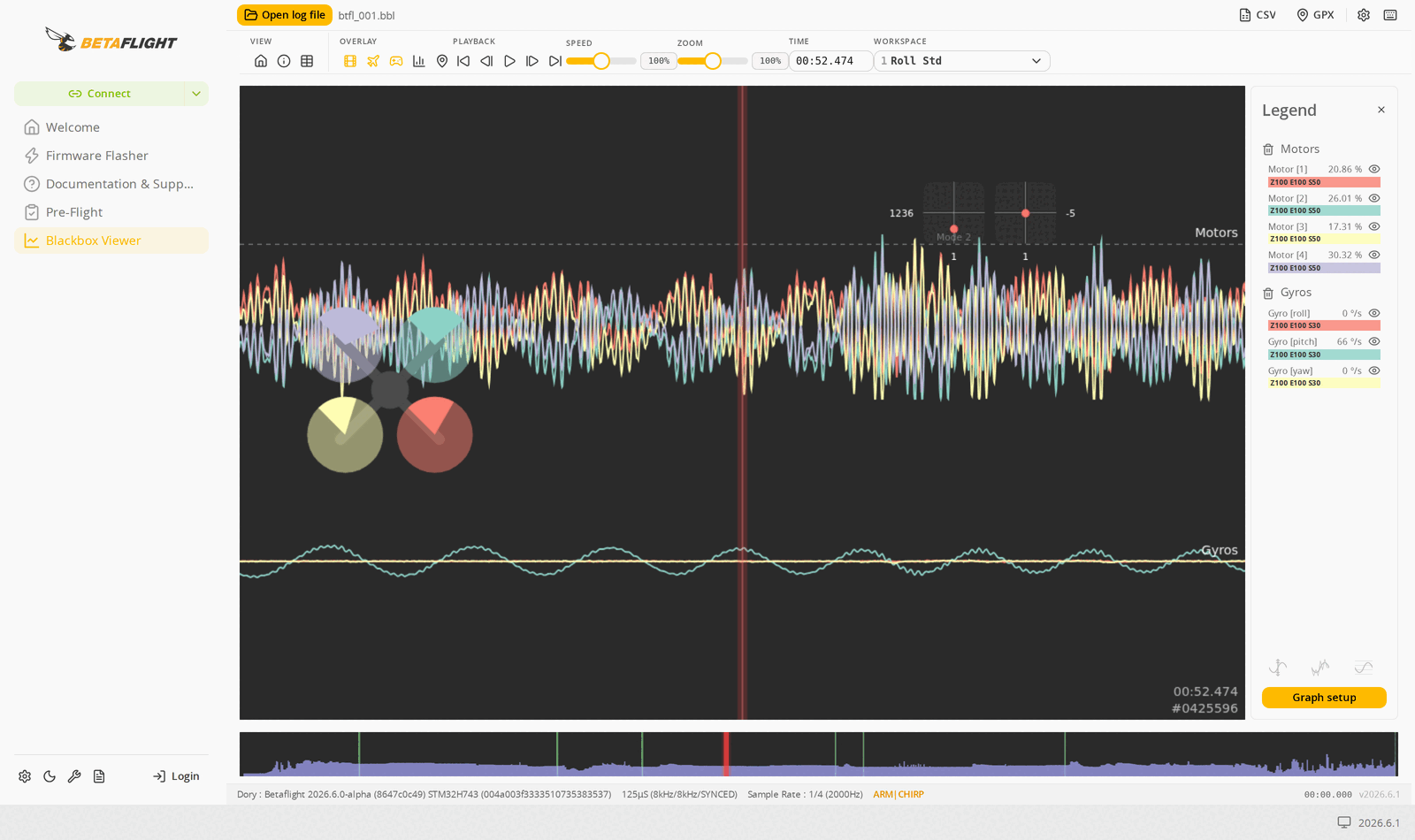
]]>For years, reviewing a log meant leaving the Betaflight App and heading to a separate site. That split is gone. Since the 2026.6 release, the log viewer is a tab in the app itself, at app.betaflight.com and in the desktop and mobile builds.
Nothing was cut down to fit. The graph view, the legend, workspaces, graph setup, the craft and stick overlays, the CSV and GPX exports, and every keyboard shortcut came across intact.
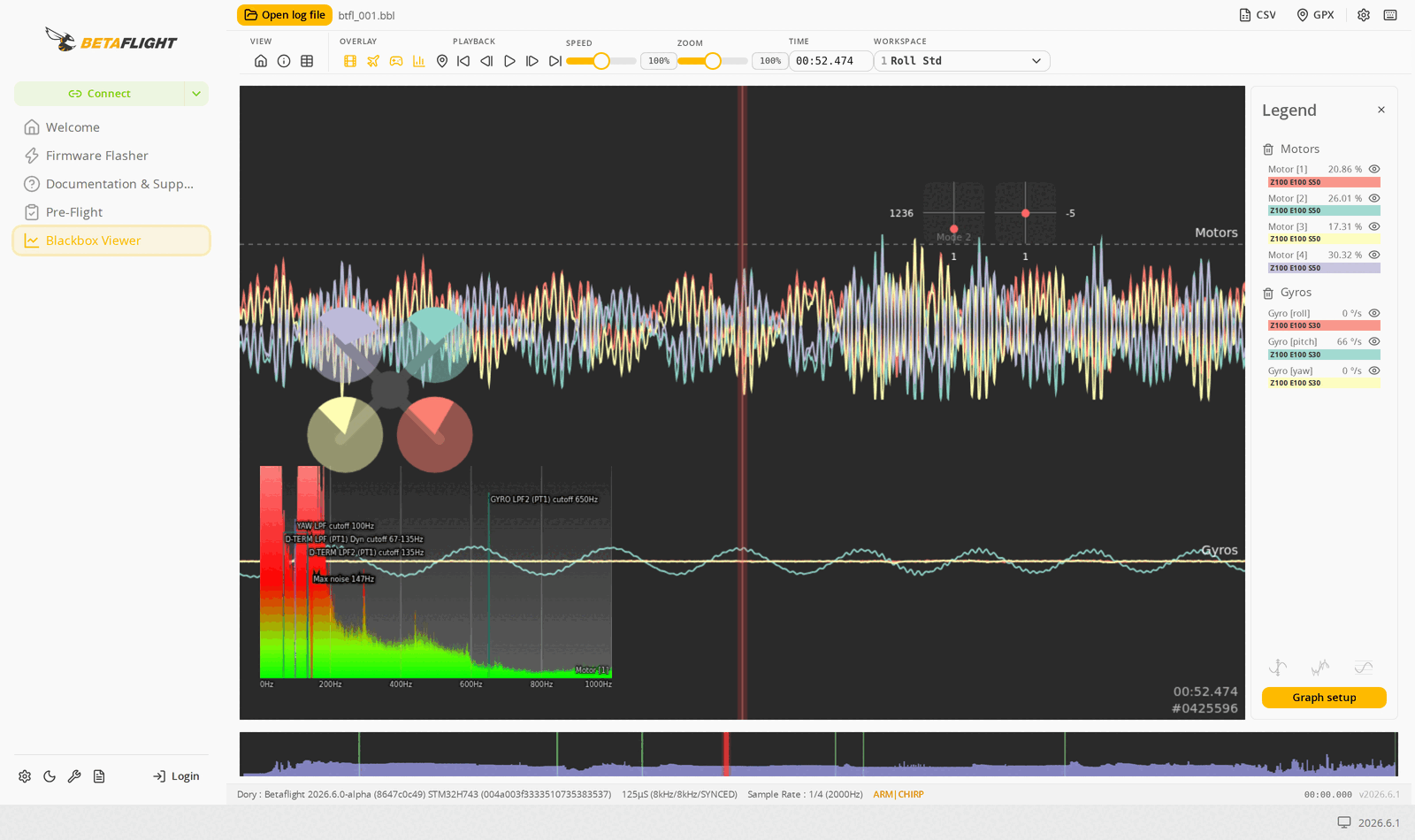
Press A and the spectrum analyser opens over the graph, with your configured filter cutoffs drawn on top so you can see exactly where each one sits against the noise you actually recorded.
Because the viewer is part of the app, it also reads the log header alongside the rest of your configuration, so the settings that produced a trace are never more than a tab away.
In the next release, a loaded log stays loaded. Switch to PID Tuning to check a value, come back, and your log, playhead position and zoom are exactly where you left them.
The standalone blackbox-log-viewer repository is now feature frozen. All new work happens in the Betaflight App, so please raise bugs and feature requests against betaflight-configurator from here on.
The repository will be archived on 1 December 2026. blackbox.betaflight.com will stay online after that as a frozen, unmaintained build of the last standalone release, so nothing you have bookmarked disappears. It simply will not receive fixes or new features.
If you are still using the standalone viewer, now is a good time to move across.
]]>The latest point release of every major version from 4.3 onwards will always remain available, regardless of age. Even once the 2-year window has passed, you'll still be able to download the final build of each major release (4.3.x, 4.4.x, 4.5.x, 2025.12.x, and so on).
We may remove any point release at any time where it's in the interests of the community to do so, for example due to a safety issue.
If you rely on an older build, we recommend downloading and archiving it locally before it ages out.
Remember that every release is tagged in our source repository, so you can clone betaflight/betaflight and build any version yourself, at any time.
]]>Get ready for a game-changer! 🚀 The Betaflight 2025.12 release officially introduces support for a powerful new target: the Raspberry Pi RP2350 aka PICO 2. This impressive little chip is set to shake up the FPV world, offering a unique blend of smart features, solid performance, and incredible value.
The Betaflight and Raspberry Pi team worked together to bring the RP2350 to you.
While the core clock speed of the RP2350 may not top the charts when compared to some rivals, it delivers a serious punch where it counts. This processor is all about working smarter, not just harder. Its architecture is designed for efficiency, ensuring a smooth and locked-in flight experience without needing the absolute highest clock rates.
One of the RP2350's standout features is its Programmable I/O (PIO). Think of PIO as a set of small, dedicated co-processors that can be programmed to handle I/O tasks independently.
This is a massive advantage for Betaflight. It means that complex, timing-sensitive tasks like running ESC protocols (like DSHOT) or receiver protocols (like CRSF) can be completely offloaded from the main CPU cores. This frees up the CPU to dedicate 100% of its resources to what matters most: executing the flight control loop as quickly and precisely as possible.
The RP2350 is a dual-core processor, with each core operating at 150mhz. While this initial release lays the crucial groundwork for the new target, future Betaflight versions will be built to take full advantage of this multicore architecture. This opens up exciting possibilities for dividing tasks between cores, leading to even greater performance, lower latency, and the ability to run more complex features without breaking a sweat.
Previous versions of the PICO have seen overclocking be officially supported so we expect the possibility of the RP2350 getting this speed boost in the future also.
Perhaps the most compelling aspect of the RP2350 is its fantastic price point. This combination of smart performance, the PIO advantage, and future-proof multicore design makes it an incredibly attractive option for hardware manufacturers.
Keep your eyes peeled! You can expect to see a new wave of innovative and affordable flight controllers featuring this great little chip hitting the market very soon. The future of flight controllers is looking bright and budget-friendly!
For more details on the RP2350 you can check out the Raspberry Pi Pico series.
]]>New Versioning Scheme & Release Cadence
To create a more predictable release schedule, we're moving to a new versioning system and development cycle, starting with the next release. The versioning scheme we will be moving to is known as CalVer or Calendar Versioning.
This style of versioning works well when there is a predictable release cadence, and that is something we are going to establish for the Betaflight project. Our release cadence will move to two major releases per year, with patch releases in between. Our target months for a major release will be June and December each year.
The New Format will be: YYYY.M.PATCH (e.g., 2025.12.0)
This means the successor to our current 4.x series will be Betaflight 2025.12.0, followed by Betaflight 2026.6.0. We will also align the Betaflight App and Firmware to the same YYYY.M releases (and cadence).
You can expect the major release version of the App and the Firmware to work together seamlessly and without issues.
To support this schedule, our development phases will be structured as follows:
Alpha:
For new feature development. Alpha builds for the next version will be available shortly after a stable release is published. This will be the master branch, and will always be available.
This will be available in the App Firmware Flasher tab when Development is selected.
"Expert mode" must be activated in the Betaflight App.
Release Candidate (RC):
A one-month feature freeze for final stabilization and testing before the official release, starting approximately one month before a major release. This will be the beginning of the *-maintenance branch. Fixes placed into the master branch will be periodically merged to the *-maintenance branch during this period.
This will be available in the App Firmware Flasher tab when Release and Release Candidates is selected.
"Show release candidates" must be activated on the Firmware Flasher tab in the Betaflight App.
Final:
The suffixes are removed from the version, the code is tagged, the release prepared and then announced.
This will be available in the App Firmware Flasher tab when the default of Release is selected.
Patch:
Periodically we will make a patch release (incrementing the patch number) for any notable bugs that need resolving. These will generally be placed into master and backported to the *-maintenance branch.
These will be available in the App Firmware Flasher tab when the default of Release is selected.
2025.12.0 Release2025.12.0-beta pre-release will be made available today around 1200 UTC. Once in beta only bug fix pull requests will be merged, with all other items held over to the next alpha pre-release.If you have any questions please feel free to ask on the Betaflight Discord.
]]>The Guinness World Records has granted the title to Ryan Lademann (USA), using his custom built drone called the XLR V3 Red. This drone powered its way to the record books by hitting 224mph (360kmh). Yes that's right folks this drone nearly hit 200knots (195knots). Many light aircraft would love to reach those speeds. The record attempt was made in Scottsdale, Arizona, USA, on 8 November 2022. What a way to finish out the year.
The team here at Betaflight congratulate Ryan on his successful attempt, and are very happy the firmware played a small part in that success. Now how can we get Ryan to update his firmware ;).
For a clip of the attempt
If you are so inclined the black box log of the attempt can be analysed here
https://drive.google.com/file/d/1K1JLV_f3W0z1dRSP84hw3UEqv5Fc_b5P/view
Don't forget to check out Ryan's page for more details on the drone
And last but not least, the details from GWR themselves
We are therefore delighted to partner with them as an official Betaflight Team Sponsor.
“Been a fan of HQ and their props for a long time. I love the way they are easy to bend back with the simple shapes which is a big plus in racing. I race ultralite quads and the Ethix range has the perfect range of sub 4g props with different amounts of pitch to suit all the different tracks i might fly. Having been in the hobby a long time the owner of HQ is a real gentleman and very supportive of the hobby, so he was the first person I reached out to when I started looking for sponsors for the Betaflight Dev team.”
“I love the J37 and P3.5 for all of my 5” builds, and the 3x2x3 for my 3” practice rig. So far a set has outlived an arm or two! HQ did an amazing job!”
“R36 is my favourite prop ever. R38 are also good. They are very durable for racing and crashing, well-designed to be fast enough, but not too fast draining the battery. R36 is an awesome combination of authority, power, and style. HQProp is always super supportive for droneracing community, love that!”
“Rocking R37 and R38 for all my 5”. The R37 work perfectly for freestyle, when i want a little bit faster, the R38 are just perfect. Also after a crash, you bend them back and they are nearly as new! Love them!”
]]>“I fly HQ J37 props exclusively for 5" freestyle because they have an awesome feel and balance - J for the Juice... HQ are quality by name and quality by nature. Thanks Zhong!”